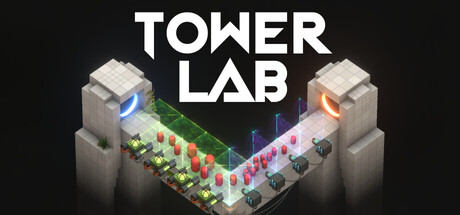
- Tower Lab playtest access centers on the playable demo and upcoming Early Access launch.
- Core mechanic: Push robots off the map instead of reducing health bars.
- Best test method: Experiment with tower placement, mass, projectile size, and physics interactions.
- Current scope: The planned Early Access build lists multiple regions, towers, cards, machines, and modes.
- Official status: Steam lists September 7, 2026 as the planned Early Access release date.
Tower Lab playtest status and access
The Tower Lab playtest is best understood as an experimental preview of a physics-driven strategy game. The official Steam listing describes a demo that has been available for more than six months, while the Early Access launch is planned for September 7, 2026. The same listing states that the game is not yet available on Steam as of September 6, 2026, so access can change around the release window.
The playtest focuses on experimentation rather than a fixed damage rotation. Robots do not use conventional health bars. Instead, towers manipulate momentum, mass, position, and projectile behavior until enemies are pushed over the edge of the map.
| Status item | Current information |
|---|---|
| Playtest format | Public demo and community testing |
| Planned Early Access date | September 7, 2026 |
| Developer | Devon Powell, Xueer Zhu |
| Game structure | Roguelite campaign, sandbox experimentation, multiple modes |
| Availability note | Steam lists the title as not yet available before launch |
Physics First
Test pushes, pulls, bounces, growth, shrinking, and launches instead of relying on damage numbers.
Open Placement
Place towers in open spaces and move them freely to discover stronger formations.
Community Testing
Share feedback, contraptions, bugs, and balance observations through the official community channels.
Treat each attempt as a laboratory session. Change one variable at a time, then compare the result before rebuilding the entire setup.
How to approach the Tower Lab playtest
A strong first session should establish how the physics systems behave before you chase advanced combinations. Start with a simple tower arrangement, observe the enemy route, and identify where a single push can create a chain reaction.
The most useful experiments usually involve spacing and timing. A tower that looks weak in isolation may become valuable when it redirects enemies into another machine, trap, or projectile. Because the system is based on interactions rather than scripted synergies, small changes in placement can produce different outcomes.
Read the arena
Locate the map edge, enemy entry route, safe building spaces, and any natural collision points. Keep the first layout simple enough to evaluate.
Place a control tower
Begin with a tower that changes enemy movement. Test its range, direction, timing, and effect on several enemy paths.
Add one interaction
Introduce a second tower, projectile, or trap. Watch whether it amplifies the first effect, redirects enemies, or creates unwanted collisions.
Adjust mass and scale
Compare normal, smaller, and larger targets or projectiles. Smaller robots are easier to push, while larger targets can offer increased rewards according to the game description.
Record the result
Keep the strongest formation, note its weaknesses, and rebuild it under a different route or enemy pressure.
| Experiment | Change | What to watch |
|---|---|---|
| Placement test | Move one tower several spaces | Range, angle, collision timing |
| Mass test | Shrink or grow a target | Push resistance and reward tradeoff |
| Combo test | Add one second tower | Chain reactions and blocked lanes |
| Projectile test | Change projectile size | Force, accuracy, and map coverage |
Do not fill every open space immediately. Excessive machinery can hide the cause of a successful or failed interaction and make the playtest harder to analyze.
Core systems worth testing
Tower Lab combines tower defense, deckbuilding, roguelite progression, and sandbox construction. The planned Early Access content lists 20 playable towers, each with its own technology tree. It also lists 26 run-modifying player cores, 14 Hazard Cores, seven physics-effect cards, eight utility cards, seven traps, and five playable machines.
These figures describe the planned Early Access scope in the official store information. They should not be treated as a final content promise because the developers note that balance, late-game content, and workshop tooling may continue to change.
| System | Listed Early Access scope | Test objective |
|---|---|---|
| Playable towers | 20 | Compare tower roles and technology paths |
| Player cores | 26 | Test run modifiers and build direction |
| Hazard Cores | 14 | Increase risk and evaluate reward pressure |
| Physics-effect cards | 7 | Add unusual movement or force interactions |
| Utility cards | 8 | Improve flexibility and setup control |
| Traps | 7 | Create additional displacement opportunities |
| Playable machines | 5 | Compare distinct starting items and abilities |
Towers
Focus on how a tower changes movement, force, or positioning. Upgrade paths should support a clear physical objective.
Cores and Cards
Use run modifiers to define risk, reward, utility, or a specific interaction pattern rather than selecting upgrades randomly.
Machines
Compare each machine by its starting items and real-time abilities. A machine can change the best opening layout.
The roguelite campaign includes meta-progression and a collection screen. Multiple game modes also use leaderboards, giving repeated playtests a longer-term objective. Sandbox tools are especially important for testing because they let players isolate systems without the pressure of a normal run.
Learn one tower, then one card interaction, then one machine ability. This sequence makes the game’s emergent systems easier to understand.
Playtest goals, feedback, and preparation
A useful playtest report should explain what happened, not only whether a build felt strong. Record the map context, tower order, relevant cards, machine choice, and the physical interaction that produced the result. This information helps separate a balance issue from an unusual collision or positioning problem.
The developers describe Discord as a central place for development discussion and mention Steam discussions, reviews, regular updates, bug reports, and Workshop experimentation as parts of the feedback loop. Use the official Tower Lab Steam page for the latest availability and store information.
Recommended first-session checklist:
- Test a basic push setup without adding unnecessary towers
- Compare normal, smaller, and larger targets
- Try at least one tower combination based on physics
- Record a repeatable setup and its main weakness
- Share clear feedback through the official community channels
| Feedback category | Useful report details |
|---|---|
| Balance | Tower, upgrade, card, or core; observed strength; comparison point |
| Physics behavior | Object positions, collision sequence, unexpected movement |
| Performance | Map, number of objects, visual effect, repeatability |
| Usability | Placement difficulty, camera comfort, unclear interface element |
| Workshop tools | Creation flow, sharing process, missing editor function |
The Steam listing also identifies accessibility options including adjustable difficulty, save anytime, camera comfort, custom volume controls, a mouse-only option, and play without quick-time events. Check the in-game settings during testing rather than assuming every option applies equally to every mode.
A concise report with reproduction steps is more valuable than a general complaint. Include the setup, the action that triggered the issue, and the expected result.
Tower Lab playtest FAQ
The following answers summarize the current playtest and Early Access information available for Tower Lab. Since development plans can change, verify launch details on the official Steam listing before planning a session.
Q: What is the Tower Lab playtest?
It is a testing experience centered on the game’s physics-driven strategy systems. The demo lets players experiment with towers, projectiles, traps, and enemy movement before or around the planned Early Access launch.
Q: When is Tower Lab planned to enter Early Access?
The official Steam page lists September 7, 2026 as the planned Early Access release date. Availability may change during the launch window, so check the store page for the current status.
Q: How do enemies work in Tower Lab?
Enemies do not use traditional health-based combat. Towers push, pull, bounce, grow, shrink, and fling robots, with the main objective being to send them off the map.
Q: What should I test first?
Start with open placement, one control tower, and one additional interaction. Then compare object mass, projectile size, timing, and positioning before exploring larger deckbuilding combinations.
The strongest playtest results come from curiosity and controlled experiments. Build small, observe carefully, and expand only after you understand the interaction.