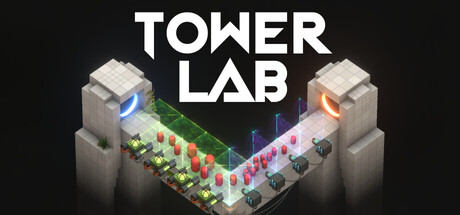
- Tower Lab early gameplay centers on physics, positioning, and pushing robots from the map.
- Enemies have no health bars, so towers create movement, momentum, and environmental danger instead.
- Start with controlled experiments before spending valuable run resources on risky combinations.
- Cores and machines define each run by changing available tools, rewards, and tactical priorities.
- Sandbox building supports free placement, level creation, and Workshop sharing during development.
Tower Lab early gameplay: Core Systems
Tower Lab is a physics-driven strategy game built around one unusual rule: enemies are not defeated by reducing health. Instead, towers push, pull, bounce, grow, shrink, and fling robotic enemies beyond the playable area. This makes Tower Lab early gameplay less about memorizing damage rotations and more about reading space, momentum, and chain reactions.
The planned Early Access release is September 7, 2026. The listed build is designed as a playable foundation, but balance, late-game content, performance, and Workshop tools may continue to change as development progresses. For the latest details, review the official Tower Lab Steam page.
Physics Combat
- Enemies do not use traditional health-based combat.
- Push, pull, bounce, and fling effects determine survival.
- Positioning matters as much as tower selection.
Flexible Building
- Towers can be placed in open spaces.
- Units can be moved to test new interactions.
- Open layouts reward experimentation over fixed patterns.
Roguelite Runs
- Draft cards and cores during a campaign.
- Purchase, reroll, remove, and upgrade run tools.
- Meta-progression supports longer-term development.
The key distinction is between force generation and force control. A tower may create a powerful shove, but that effect is only useful if the target has somewhere dangerous to go. Open edges, obstacles, slopes, and nearby enemies can turn a simple interaction into a larger chain reaction.
| System | What it changes | Early gameplay priority |
|---|---|---|
| Physics effects | Enemy movement and projectile behavior | Learn how force interacts with terrain |
| Tower placement | Angle, spacing, and chain potential | Leave room for movement |
| Cards and cores | Run modifiers and available options | Build around a clear interaction |
| Machines | Starting items and real-time abilities | Match the machine to your preferred pace |
| Meta-progression | Long-term unlock and collection goals | Improve consistency across attempts |
Treat every placement as an experiment. Before committing to a large setup, test whether the tower changes an enemy’s direction, speed, size, or collision behavior in a useful way.
Early Gameplay Setup: A Safe Opening
A strong opening in Tower Lab should create reliable control before it seeks dramatic combos. The first objective is not to build the most complicated machine possible. It is to establish a repeatable way to redirect enemies toward an edge or another hazard.
Use the following process whenever you enter an unfamiliar level or begin a new run.
Read the Arena
Identify the available edges, narrow lanes, obstacles, and open placement zones. Look for areas where a small movement effect could become a larger fall or collision. Avoid placing every tower in the center before understanding the map.
Choose a Primary Force
Select an early tower or card that provides a dependable push, pull, bounce, or projectile interaction. Use it as the foundation of the run rather than selecting several unrelated effects at once.
Create a Control Lane
Leave a clear route from the enemy approach to the intended exit point. A control lane gives your main effect room to work and makes failed experiments easier to diagnose.
Add One Supporting Interaction
Introduce a second tower only after the first effect is predictable. Look for combinations that extend momentum, redirect targets, or improve projectile control without blocking the original route.
Reposition and Refine
Move towers freely when the arrangement underperforms. Compare the new angle, distance, and timing against the original layout before adding more complexity.
The safest early arrangement usually has three functional zones: an entry zone where enemies appear, a control zone where towers alter their movement, and a finish zone near the map edge or another decisive hazard. This structure helps prevent accidental interference between towers.
| Setup phase | Main question | Good decision |
|---|---|---|
| Arena read | Where can enemies leave the map? | Mark edges and high-risk routes |
| Primary effect | What moves enemies reliably? | Pick one repeatable force |
| Control lane | Is there enough open space? | Keep a clear movement corridor |
| Support effect | Does the second tower improve the first? | Add only a complementary interaction |
| Refinement | What caused the failure? | Change one variable at a time |
Adding several towers immediately can hide the reason a setup succeeds or fails. Build in layers, test each interaction, and keep a fallback route available for enemies that resist the main plan.
Towers, Cards, Cores, and Machines
The Early Access build is planned to include 20 playable towers, each with its own tech tree and physics-based interactions. It also lists 26 run-modifying player cores, 14 Hazard Cores, seven physics-effect cards, eight utility cards, seven traps, and five playable machines. These numbers describe the planned Early Access foundation as of September 6, 2026; individual systems may be tuned during development.
Rather than ranking every option without a specific patch or build, evaluate tools by the role they serve in your current run.
Control Tools
Push, pull, and redirection effects. Best for shaping enemy paths and protecting a preferred lane.
Momentum Tools
Bounce and fling interactions. Strong when the arena provides edges, gaps, or collision opportunities.
Scale Tools
Growth and shrinking effects. Use size changes to alter pushing difficulty, projectile power, or reward risk.
Utility Tools
Rerolls, removals, upgrades, and supporting cards. These improve consistency when a run needs correction.
Machines define a run’s starting identity through unique starting items and real-time abilities. The best machine is therefore situational. A machine that gives strong early control may be preferable while learning a region, while another may suit players who enjoy higher-risk physics experiments.
| Content type | Listed Early Access amount | How to evaluate it |
|---|---|---|
| Playable towers | 20 | Check the tower’s force, range, tech tree, and interactions |
| Player cores | 26 | Favor modifiers that reinforce the run’s main plan |
| Hazard Cores | 14 | Use risk when the expected reward supports the layout |
| Physics-effect cards | 7 | Prioritize effects that extend or redirect momentum |
| Utility cards | 8 | Use for consistency, recovery, and build correction |
| Traps | 7 | Place where enemy movement is already predictable |
| Playable machines | 5 | Match starting tools and abilities to your preferred strategy |
A useful rule for card selection is direction before intensity. A smaller effect that consistently moves enemies toward a known exit can outperform a stronger effect that creates random collisions. Once a run has stable control, add scaling effects, traps, or reward-focused risks.
The strongest runs are not necessarily built from individually powerful pieces. Prioritize combinations that produce a clear sequence: redirect the enemy, preserve momentum, and finish near the map boundary.
Physics Strategy and Risk Management
Tower Lab rewards players who understand how small changes affect the whole arena. A robot’s size, a projectile’s scale, or a tower’s position can change collision outcomes. Because enemies can be grown or shrunk, players must also decide when to pursue safer control and when to accept additional risk for increased rewards.
Shrinking robots makes them easier to push, while growing them can increase reward potential. Growing projectiles can make them more powerful, but a larger projectile may also create unwanted collisions or reduce precision. These choices should be connected to the arena rather than made automatically.
| Situation | Recommended approach | Risk to monitor |
|---|---|---|
| Narrow route | Use controlled push or pull effects | Enemies may jam together |
| Open arena | Test bounce and fling interactions | Momentum may send targets away from your plan |
| Heavy enemy | Consider shrinking before repeated pushes | Reward potential may be reduced |
| High-value target | Grow only when control is reliable | A larger target may resist redirection |
| Projectile setup | Increase size after confirming the angle | Oversized projectiles can disrupt nearby towers |
| Unstable combo | Remove or reposition one component | Multiple changes make errors difficult to trace |
When an experiment fails, do not immediately discard the entire run. First ask whether the problem came from angle, distance, timing, mass, or collision order. Changing one variable at a time makes the physics easier to understand and helps you identify reusable patterns.
A practical troubleshooting sequence is:
- If enemies barely move, increase contact quality or reduce their effective resistance.
- If enemies move in the wrong direction, adjust the tower angle or relocate the control point.
- If a chain reaction stops early, create more space between interacting towers.
- If projectiles become difficult to aim, reduce their size or simplify the surrounding layout.
- If rewards are tempting you into unsafe growth effects, secure the route before increasing risk.
Growth effects can improve rewards or projectile power, but they also change control requirements. Use them after your escape route is dependable, not before the arena is understood.
Progression, Sandbox, and Early Access Goals
The planned Early Access version includes a roguelite deckbuilding campaign with three regions, multiple game modes, meta-progression, a collection screen, and leaderboards for multiple modes. It is intended to be playable from start to finish while continuing to expand through player feedback.
Sandbox mode is especially valuable for learning early gameplay. The game supports free tower placement and level creation, allowing players to test interactions without treating every discovery as a high-stakes campaign decision. Player-created levels are also planned for Workshop sharing, although Workshop tooling remains an area under development.
Early Gameplay Practice Goals:
- Create one reliable push or pull route to a map edge
- Test a tower combination with only one supporting effect
- Compare a normal projectile with a larger projectile
- Use a core or card that reinforces the run's primary interaction
- Practice repositioning towers before adding more pieces
The development roadmap also includes additional towers, traps, units, machines, cores, physics cards, utility cards, rewards, levels, enemies, and regions. Planned improvements include balance, performance, visual polish, campaign content, and player-created sandbox levels. These plans may evolve during Early Access.
| Progression area | Current planned foundation | Future direction |
|---|---|---|
| Campaign | Three regions and roguelite deckbuilding | More levels, enemies, and regions |
| Build variety | Towers, cores, cards, traps, and machines | Expanded roster and additional rewards |
| Long-term systems | Meta-progression and collection screen | Ongoing tuning and content growth |
| Competitive tracking | Multiple game-mode leaderboards | Further balance and performance work |
| Sandbox | Level creation and open experimentation | Improved Workshop tooling and sharing |
Tower Lab is planned to remain in Early Access for roughly six to twelve months, according to the developer information on the Steam listing. The final version is planned to add content and polish, but the development timeline and feature priorities can change.
Use sandbox experimentation to discover physics interactions, then apply only the most reliable patterns in campaign runs. This reduces wasted attempts while preserving room for creative builds.
Tower Lab Early Gameplay FAQ
Q: What is the main idea behind Tower Lab early gameplay?
Tower Lab early gameplay focuses on using physics instead of health-based damage. Towers push, pull, bounce, grow, shrink, and fling robots, with victory usually coming from sending enemies beyond the map edge.
Q: How many towers are planned for Early Access?
The planned Early Access build includes 20 playable towers. Each tower has its own tech tree and can interact with other towers through physics-based combinations.
Q: What should beginners prioritize during a new run?
Start with one reliable force, such as a controlled push or pull, and create a clear route toward an edge. Add a supporting tower only after the first interaction is predictable.
Q: Does Tower Lab include a sandbox mode?
Yes. Tower Lab is designed for open experimentation, with flexible tower placement and level creation. Player-created levels and Workshop tooling are planned features that may continue to develop during Early Access.
Approach each run as a physics puzzle. Establish control first, build around one clear interaction, and increase risk only when the arena supports it.