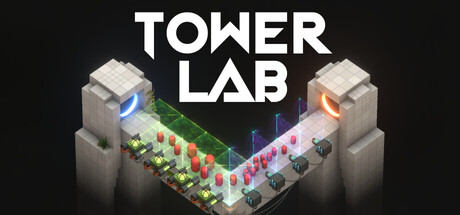
- Tower Lab demo: Explore physics-driven tower defense before the planned September 7, 2026 release.
- Core mechanic: Push, pull, bounce, grow, shrink, and fling robots instead of reducing health bars.
- Best approach: Experiment with tower placement and combinations before committing to a run.
- Progression focus: Draft cards, select cores, improve towers, and adapt your build around physics.
Tower Lab Demo Overview
The Tower Lab demo introduces an experimental strategy game where robots are removed from the battlefield through physics rather than conventional damage. Enemies have no health values to drain. Instead, your towers manipulate position, momentum, mass, and projectile behavior until robots are pushed off the map.
The demo is best understood as a sandbox for discovering interactions. Tower placement is flexible, and combinations are based on physical behavior rather than a fixed list of scripted combo recipes. This gives each test run room for experimentation, especially when you alter the size of robots or projectiles.
The official Steam page reported on June 22, 2026, that the demo had been live for more than six months. Availability and content can change as development moves toward Early Access, so check the official Tower Lab Steam page before planning a session.
Treat the demo as a laboratory, not only as a campaign preview. Test one tower interaction at a time so you can identify which placement or physics effect created the result.
Confirmed Demo Focus
| Feature | What to Expect | Practical Use |
|---|---|---|
| Physics combat | Robots are pushed, pulled, bounced, grown, shrunk, or flung | Build around displacement instead of damage |
| Flexible placement | Towers can be placed and moved in open spaces | Reposition structures when an interaction fails |
| Tower combinations | Synergies emerge from physical interactions | Test adjacent, chained, and directional setups |
| Roguelite structure | Runs use cards, cores, upgrades, and rerolls | Adapt your build instead of following one permanent loadout |
| Sandbox direction | The game supports experimentation and level creation plans | Explore unusual layouts and creative challenge ideas |
What the Demo Teaches
A successful first session should answer four questions:
- Which towers create reliable movement?
- Which projectiles become more useful after changing size?
- How does robot mass affect risk and reward?
- Which cards or cores support the placement style you naturally prefer?
Do not measure progress only by how quickly a wave ends. A failed experiment can still reveal whether a tower needs more space, a different angle, or a lighter target.
Core Physics and Tower Interactions
Tower Lab replaces traditional damage calculations with physical outcomes. A tower may create force, redirect a target, change the size of a projectile, or interact with another tower to produce a stronger chain reaction. The central skill is reading the battlefield and predicting where momentum will carry each robot.
The game allows towers to interact through real physics. That means a strong layout is not necessarily the one with the highest visible power value. A compact arrangement may create repeated collisions, while a spread-out design may provide better angles for pushing enemies toward the edge.
A powerful effect can become inefficient if it moves a robot away from the exit or into a position where later towers cannot reach it. Always consider the target’s next landing point.
Physics Effects to Test
| Effect | Main Function | Useful Question |
|---|---|---|
| Push | Moves a robot away from an impact or force source | Does the direction lead toward the map edge? |
| Pull | Draws a target into a setup or collision zone | Can another tower capitalize on the new position? |
| Bounce | Redirects movement through repeated contact | Is there enough open space for multiple rebounds? |
| Grow | Increases the size or mass of a target or projectile | Does the higher reward or power justify extra control difficulty? |
| Shrink | Makes a robot easier to push | Can a lighter target be removed before it reaches danger? |
| Fling | Launches a target with strong displacement | Is the launch angle consistent enough to repeat? |
Mass, Risk, and Reward
Changing mass is one of the most important decisions described for the game. Shrinking robots can make them easier to push, which supports safer removal. Growing robots can increase rewards, but larger targets may be more difficult to control. Projectiles can also be grown to increase their power.
Use mass changes with a clear purpose:
- Shrink early targets when control and reliable removal matter more than reward.
- Grow a robot when your layout already has a dependable launch or collision route.
- Grow projectiles when their additional power improves the entire chain rather than one isolated hit.
- Avoid changing mass automatically if the battlefield is already crowded or unstable.
Push Setup
Use directional force to move robots toward an edge. Best when the path is open and easy to read.
Bounce Chain
Use walls, towers, or objects to redirect targets. Strong potential, but sensitive to spacing.
Mass Control
Shrink for easier movement or grow for increased rewards. Choose based on control confidence.
Projectile Growth
Increase projectile size for more power. Pair it with a layout that keeps shots useful.
First-Run Setup Guide
The most useful demo routine is a controlled test run. Begin with a simple layout, observe one interaction, and then make a single change. This method makes the game’s emergent systems easier to understand than placing every available tool at once.
Change one major variable at a time: tower position, target mass, projectile size, or card choice. You will learn faster when each result has a clear cause.
Survey the Battlefield
Identify the map edge, open lanes, likely collision points, and spaces where towers can be moved safely. Decide which direction should carry robots out of danger.
Place a Reliable Control Tower
Start with a tower that creates clear movement. Watch the direction, distance, and landing position before adding another structure.
Add One Interaction
Place a second tower where it can receive the robot or projectile from the first. Look for a repeatable push, pull, bounce, or launch.
Test Mass or Projectile Size
Shrink a robot for easier control, or grow a projectile for greater power. Compare the result with the original layout.
Commit to the Better Pattern
Keep the arrangement that removes targets consistently, then use upgrades, rerolls, or additional cards to strengthen that pattern.
Demo Session Workflow
| Phase | Action | Success Signal |
|---|---|---|
| Observe | Watch the initial movement without changing every tower | You understand the main danger direction |
| Establish | Create one dependable displacement route | Robots move toward a useful landing zone |
| Combine | Add a second physical interaction | The chain produces more control or reach |
| Adjust | Change mass, projectile size, or placement | The result improves without creating new instability |
| Repeat | Rebuild the pattern on the next challenge | The strategy works beyond one accidental interaction |
This workflow also helps when a run fails. Instead of restarting with a completely different build, identify the last interaction that remained reliable and rebuild around it.
Build Planning, Cards, and Machines
Tower Lab uses a roguelite campaign structure with deckbuilding, player cores, physics-effect cards, utility cards, traps, upgrades, rerolls, and tower removal. The Early Access plan lists 20 playable towers, 26 run-modifying player cores, 14 Hazard Cores, 7 physics-effect cards, 8 utility cards, 7 traps, and 5 playable machines.
These figures describe the planned Early Access state listed for 2026, not a guarantee that every item appears in the demo. Use the demo to learn the underlying interactions first, then evaluate progression choices as the available content expands.
Choose cards and cores that reinforce your strongest physical pattern. A smaller set of compatible effects is usually easier to control than a broad collection with no shared direction.
Build Priorities
| Priority | Recommended Focus | Why It Matters |
|---|---|---|
| Control | Reliable push, pull, or launch behavior | Consistent displacement is the foundation of survival |
| Positioning | Towers with useful spacing and angles | Physics effects depend heavily on where objects interact |
| Conversion | Cards that improve an existing pattern | Builds become stronger when upgrades support proven behavior |
| Flexibility | Rerolls, utility effects, or removal options | Failed experiments can be corrected during a run |
| Risk | Growth effects and high-force interactions | Greater rewards may require more precise control |
Planned Early Access Scope
| System | Listed 2026 Scope | Development Note |
|---|---|---|
| Towers | 20 playable towers | Each tower has its own tech tree and physics interactions |
| Cores | 26 player cores and 14 Hazard Cores | Cores modify runs and expand decision-making |
| Cards | 7 physics-effect cards and 8 utility cards | The roster is planned to grow beyond this base |
| Traps | 7 traps | Traps add another layer of battlefield control |
| Machines | 5 playable machines | Each machine has unique starting items and real-time abilities |
| Campaign | 3 regions at Early Access launch | Campaign includes roguelite deckbuilding and meta progression |
The developers also plan more towers, traps, units, machines, cores, cards, rewards, levels, enemies, and regions after the initial release. Player-created levels and expanded Workshop tooling are planned areas, while balance, late-game content, and performance remain subject to development feedback.
Demo Checklist and Release Context
Use this checklist to turn a short demo session into useful preparation for the planned Early Access launch. The goal is not to memorize one optimal build. It is to understand how the game responds to placement, mass, force, and chain interactions.
Record the layout that produced your most reliable removal pattern. A simple note about tower order and target direction can be more valuable than chasing a single high-risk result.
Demo Practice Checklist:
- Identify the safest map edge and the main robot approach route
- Test one push, pull, bounce, or fling interaction
- Compare a normal target with a shrunk target
- Grow one projectile and evaluate whether the added power improves the setup
- Save a repeatable tower layout for future runs
Release and Platform Details
The Steam listing identifies Tower Lab as an action, casual, indie, simulation, and strategy title planned for Early Access on September 7, 2026. The page lists Windows 10 64-bit and macOS 12.0 Monterey or later requirements, along with single-player support, Steam Achievements, Steam Workshop, Steam Cloud, leaderboards, an included level editor, and Steam Deck compatibility marked as Playable.
| Item | Listed Information |
|---|---|
| Planned release | September 7, 2026 |
| Development stage | Early Access |
| Developers | Devon Powell and Xueer Zhu |
| Publisher | Devon Powell and Xueer Zhu |
| Modes and features | Single-player, leaderboards, Workshop, level editor |
| Accessibility | Adjustable difficulty, save anytime, camera comfort, custom volume controls, mouse-only option |
| Storage | 2 GB available space listed for Windows and macOS |
The developers expect Early Access to last roughly six to twelve months. They describe the current core as playable from start to finish with multiple modes and meta progression, while balance, late-game content, and Workshop tools continue to be developed.
For the most reliable access information, use the Tower Lab Steam listing and its developer announcements. The page may change as the September 2026 release approaches.
Tower Lab Demo FAQ
The questions below cover the most important expectations for new players evaluating the demo and preparing for the next development stage.
The demo’s main lesson is physical problem-solving: control space, create repeatable interactions, and use risk-based upgrades with intent.
Q: What is the Tower Lab demo?
It is a playable preview of a physics-driven tower defense strategy game. The central objective is to push robots off the map rather than reduce traditional health bars.
Q: Does Tower Lab use normal damage numbers?
The game description states that enemies have no health and that there are no damage numbers. Towers instead push, pull, bounce, grow, shrink, and fling enemies through physics interactions.
Q: What should I test first in the demo?
Start with one reliable displacement effect, then add a second tower that can receive or redirect the target. After that, compare normal, shrunk, and enlarged targets where the layout allows.
Q: When is Tower Lab planned to enter Early Access?
The Steam page lists September 7, 2026 as the planned release date. The developers expect Early Access to last roughly six to twelve months, though development plans can change.