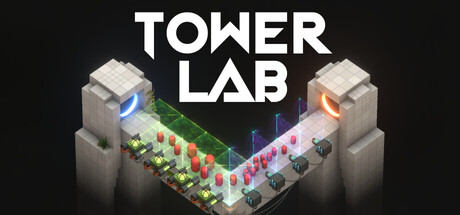
- Tower Lab steam status: Early Access is planned for September 7, 2026, with the game currently listed as unavailable.
- Core mechanic: Push robots from the map instead of reducing traditional health bars.
- Best starting focus: Learn tower placement, mass control, and physics interactions before chasing complex builds.
- Run structure: Draft cards, select cores, improve towers, and adapt your machine to each scenario.
- Long-term features: Meta progression, leaderboards, Steam Workshop, and a level editor support continued experimentation.
Tower Lab steam Status and Core Concept
As of September 6, 2026, Tower Lab steam information lists the title as an upcoming Early Access strategy game from Devon Powell and Xueer Zhu. The planned release date is September 7, 2026. The store listing indicates that the game is not yet available, so players should check the official Tower Lab Steam page for the latest release status.
Tower Lab combines tower defense, roguelite deckbuilding, sandbox construction, and physics simulation. Its defining rule is simple: enemies do not rely on conventional health bars. Instead, towers push, pull, bounce, grow, shrink, and fling robot enemies toward the edge of the map.
This changes how you evaluate every placement. Damage-per-second is not the central measurement. Position, momentum, mass, timing, and tower interactions determine whether a defense succeeds.
| Feature | What It Means | Why It Matters |
|---|---|---|
| Physics defense | Towers manipulate enemy movement instead of dealing standard damage | Placement and momentum become core strategic resources |
| Roguelite campaign | Runs use cards, cores, rewards, and upgrades | Each attempt can develop a different build |
| Flexible construction | Towers can be placed and moved in open spaces | Experimentation is part of normal progression |
| Tower combinations | Interactions are based on physics rather than fixed scripts | Creative combinations can outperform isolated upgrades |
| Sandbox tools | Players can build and decorate levels | The level editor supports testing and community creations |
Control
- Push and pull enemy formations
- Manipulate trajectories near hazards
- Turn map edges into the primary objective
Build
- Place towers in open spaces
- Combine towers through physical interactions
- Adjust the setup as the run develops
Adapt
- Draft cards and choose cores
- Balance risk against rewards
- Change tactics for different enemies and regions
Treat the map edge as your win condition. A tower with modest force can be more valuable than a stronger tower if it creates a reliable launch angle.
How to Start a Tower Lab Run
A strong opening in Tower Lab begins with observation rather than immediate spending. The game provides multiple ways to purchase, reroll, remove, and upgrade components during a roguelite campaign. Use those choices to create a coherent physical system instead of collecting unrelated effects.
The current Early Access plan describes 20 playable towers, each with its own technology tree. It also lists 26 player cores, 14 Hazard Cores, seven physics-effect cards, eight utility cards, seven traps, and five playable machines. These figures describe the planned Early Access content identified in the store information and may change during development.
Read the Arena
Identify the direction enemies are approaching, the nearest map edges, and any space where a tower can create a useful angle. Avoid filling the arena before you understand the movement pattern.
Choose a Clear Function
Give each early tower a job such as pushing, pulling, bouncing, enlarging projectiles, shrinking robots, or controlling a route. A simple two-tower plan is easier to test than a crowded setup.
Test the Interaction
Watch how the first towers affect one another. Look for repeatable movement, stable launch paths, and situations where one effect improves the next effect.
Spend on Consistency
Purchase, reroll, remove, or upgrade with a specific goal. Prioritize changes that make your physical sequence easier to repeat across incoming groups.
Review Before the Next Choice
After each encounter, decide whether the problem was weak force, poor positioning, excessive enemy mass, or bad timing. Upgrade the cause rather than reacting only to the result.
| Opening Decision | Safer Approach | Riskier Approach |
|---|---|---|
| Tower placement | Leave room for movement and retuning | Build a dense cluster immediately |
| Card choice | Select effects that support your current physical plan | Draft unrelated effects for future possibilities |
| Upgrade choice | Improve a reliable interaction | Invest in an interaction you have not tested |
| Robot mass | Shrink difficult targets when control is the priority | Grow targets before confirming your launch power |
| Reroll use | Save rerolls for a genuine build gap | Spend them on minor upgrades without a clear purpose |
More towers do not automatically create better defense. Unplanned interactions can disrupt useful trajectories, consume open space, and make it harder to identify which effect caused a failure.
Physics Defense, Mass, and Tower Synergy
Tower Lab’s most important strategic distinction is the absence of conventional damage numbers. Enemies are controlled through physical effects, making every defense a problem of movement and force.
Shrinking robots makes them easier to push, while growing them can increase rewards but also raises the difficulty of moving them. Projectiles can also be grown to increase their power. This creates a direct risk-and-reward decision: increase the value of a target only when your setup can still control it.
The best combinations are not necessarily the towers with the highest individual strength. A useful chain might begin with a pull, continue with a bounce, and finish with a push toward the edge. The exact value depends on spacing and timing, so test combinations in open areas whenever possible.
| Physical Effect | Primary Use | Main Risk | Practical Response |
|---|---|---|---|
| Push | Send enemies toward an edge or hazard | Poor angle can redirect enemies into safer space | Place the tower where its force supports the final route |
| Pull | Gather or reposition targets | Clustering can increase local pressure | Pair it with a follow-up effect that controls the group |
| Bounce | Redirect movement and create repeated impacts | Unstable angles can scatter targets | Use nearby boundaries and predictable geometry |
| Shrink | Reduce enemy mass and improve control | Lower target size may affect reward value | Use when survival and removal matter more than payout |
| Grow | Increase target or projectile scale | Larger enemies may resist movement | Reserve it for setups with dependable force |
| Trap | Add a controlled hazard or interruption | Poor timing can waste the effect | Combine it with a route that keeps enemies in range |
When evaluating a tower, ask three questions:
- Does it move enemies toward the edge?
- Does it make another tower more reliable?
- Can it function without blocking the space needed for later adjustments?
A successful physics build should have a repeatable sequence: position the target, apply the main force, correct the trajectory, and finish the removal.
| Build Pattern | Suggested Sequence | Best Use |
|---|---|---|
| Direct launch | Push, correct, eject | Simple arenas with clear edge access |
| Group control | Pull, cluster, bounce, eject | Encounters where enemies arrive together |
| Lightweight control | Shrink, push, redirect | Heavy targets that resist normal movement |
| Projectile scaling | Grow projectile, apply force, repeat | Setups built around stronger ranged interactions |
| Trap route | Pull, delay, trap, finish | Lanes where timing can be controlled |
Machines, Cores, and Run Progression
Machines define different run styles through unique starting items and real-time abilities. The Early Access description lists five playable machines, but it does not identify every machine by name or provide a complete ranking. For that reason, choose a machine according to the tools it gives you and the kind of physical system you want to build.
Cores modify a run, while Hazard Cores add another layer of challenge or reward. The correct choice depends on your current build, the available tower interactions, and your confidence in controlling enemy mass.
Meta progression and a collection screen provide goals beyond a single attempt. Leaderboards are planned for multiple game modes, creating an additional reason to refine consistent strategies rather than relying only on favorable physics.
| Progression Layer | Role in a Run | Recommended Mindset |
|---|---|---|
| Machine | Defines starting items and real-time abilities | Build around its starting identity |
| Player Core | Modifies the run and supports a chosen strategy | Select effects that improve consistency |
| Hazard Core | Adds a higher-risk modifier | Use after learning the normal interaction |
| Physics Card | Changes how physical effects behave | Test before committing to a major route |
| Utility Card | Supports setup, control, or flexibility | Fill a specific weakness |
| Tower Tech Tree | Improves an individual tower | Upgrade the tower carrying your main plan |
| Meta Progression | Preserves longer-term advancement | Treat each run as progress, even after failure |
Early Access Preparation Checklist:
- Confirm the September 7, 2026 release status on the official Steam page
- Learn how pushing, pulling, bouncing, growing, and shrinking affect robot movement
- Start with a small tower combination that has a clear removal route
- Test mass changes before using them for higher rewards
- Review machine, core, card, and tower upgrade choices after every encounter
Early Access content is intended to evolve through balance changes, additional towers, enemies, regions, rewards, and community feedback. Keep flexible builds while systems are being tuned.
Features, Platforms, and Practical Setup Notes
The Steam listing identifies Tower Lab as a single-player title with Steam Achievements, Steam Workshop, Steam Cloud, Steam Leaderboards, Family Sharing, and an included level editor. It is also marked as playable on Steam Deck. These features support both structured runs and experimentation beyond the campaign.
The game is planned for Windows and macOS. The listed minimum requirements call for 8 GB of memory and approximately 2 GB of available storage. Windows requires Windows 10 64-bit, while the macOS listing requires macOS 12.0 Monterey or later.
| System | Minimum Requirement |
|---|---|
| Windows OS | Windows 10 64-bit |
| macOS | macOS 12.0 Monterey or later |
| Memory | 8 GB RAM |
| Windows CPU | Intel Core i5-4590, AMD FX-8350, or equivalent |
| macOS CPU | Apple M1 or Intel Core i5 from 2018 or newer |
| Windows GPU | NVIDIA GTX 960, AMD R9 280, or equivalent with 2 GB VRAM |
| macOS GPU | Apple M1, Intel Iris Plus Graphics 640, or AMD Radeon Pro 555 |
| Storage | 2 GB available space |
| DirectX | Version 11 for Windows |
Accessibility options listed on the store page include adjustable difficulty, save anytime, camera comfort, custom volume controls, a mouse-only option, and gameplay without quick-time events. The interface is listed in English and 16 additional languages, including Spanish, Japanese, Brazilian Portuguese, Simplified Chinese, Traditional Chinese, Korean, French, German, Italian, Polish, Russian, Thai, Turkish, Ukrainian, Vietnamese, and Spanish from Spain.
Before committing to longer runs, adjust camera comfort, volume, and input settings to match your preferred control style. A clear view helps when small changes in trajectory decide the outcome.
The planned Early Access roadmap includes more towers, traps, units, machines, cores, physics cards, utility cards, rewards, levels, enemies, regions, and player-created sandbox levels. The developers also describe ongoing balance, performance, polish, and Workshop tooling work.
Because the store page lists Tower Lab as not yet available on September 6, 2026, wishlist and release information should be checked directly through the official Steam listing rather than relying on older announcements.
Tower Lab steam FAQ
Q: When is Tower Lab planned to release on Steam?
The listed planned release date is September 7, 2026. On September 6, 2026, the Steam page still describes the game as not yet available, so check the official listing for the current status.
Q: How does Tower Lab differ from a traditional tower defense game?
Enemies do not use conventional health bars. Towers manipulate physics by pushing, pulling, bouncing, growing, shrinking, and flinging robots off the map.
Q: What content is planned for the Early Access version?
The listed Early Access plan includes 20 towers, 40 total cores across player and Hazard Cores, physics and utility cards, seven traps, five machines, meta progression, multiple game modes, and leaderboards.
Q: Does Tower Lab support user-created levels?
Yes. The store information lists Steam Workshop support and an included level editor. Player-created sandbox levels are also part of the planned Early Access direction.
Start with one dependable physics chain, keep open space for adjustments, and expand your build only after the first interaction behaves consistently.