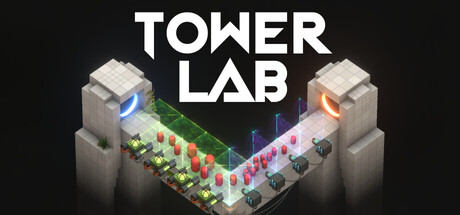
- Tower Lab on steam is a physics-driven roguelite tower defense game planned for September 7, 2026.
- Core mechanic: Push, pull, bounce, grow, shrink, and fling robots instead of reducing health bars.
- Build system: Draft cards, combine towers, and create interactions through real physics.
- Early Access scope: The planned launch includes multiple regions, modes, meta progression, and 20 playable towers.
- Setup focus: Confirm your operating system, hardware, input preferences, and available storage before launch.
Tower Lab on steam: What to Expect
Tower Lab is a strategy game built around physical interactions rather than conventional damage calculations. Its enemies do not use health bars. Instead, towers manipulate their position, size, momentum, and movement until robots are pushed off the map.
The Steam listing classifies the title across strategy, simulation, action, casual, indie, and Early Access categories. It also uses tags such as Physics, Roguelite, Tower Defense, Deckbuilding, Sandbox, Building, and Singleplayer. This combination makes Tower Lab a good fit for players who enjoy experimentation as much as traditional defensive planning.
The listed developers and publishers are Devon Powell and Xueer Zhu. Steam lists a planned release date of September 7, 2026, while also identifying the title as an upcoming Early Access release. The page states that the game is not yet available at the time of the current listing.
| Feature | What it means |
|---|---|
| Genre mix | Strategy, simulation, action, casual, indie |
| Main objective | Push robots off the map |
| Combat model | Physics interactions instead of health damage |
| Player mode | Single-player |
| Release status | Planned Early Access release |
| Planned date | September 7, 2026 |
Physics Defense
Towers use force, movement, mass, and projectile behavior to control enemies.
Roguelite Runs
Improve each run through purchases, rerolls, removals, upgrades, rewards, and run-modifying cores.
Tower Combinations
Place towers freely and build synergies that emerge from their interactions.
Sandbox Creation
Use the level editor and planned Workshop support to build and share custom levels.
Treat every tower placement as part of a machine. A strong setup is not only about tower strength; it is about how force travels through the entire arrangement.
Core Mechanics and Build Planning
Tower Lab’s central design removes the usual damage-per-second formula. A projectile can become more powerful when enlarged, while a robot can become easier to push when reduced in size. Growing an enemy may also increase its reward, creating a risk-and-reward decision during a run.
The game allows towers to be placed in open spaces and moved freely. This supports a sandbox-style approach in which players can test angles, spacing, chain reactions, and launch paths. Because interactions are based on physics, a tower’s value depends on its position and relationship with nearby machines.
The Early Access description lists 20 playable towers, each with its own technology tree. It also lists 26 run-modifying Player Cores, 14 Hazard Cores, seven physics-effect cards, eight utility cards, seven traps, and five playable machines.
| System | Listed content | Practical role |
|---|---|---|
| Playable towers | 20 | Main defensive tools with individual tech trees |
| Player Cores | 26 | Modify the direction of a run |
| Hazard Cores | 14 | Add specialized run conditions |
| Physics cards | 7 | Change physical behavior |
| Utility cards | 8 | Support positioning and control |
| Traps | 7 | Add additional map interactions |
| Machines | 5 | Define run style with starting items and real-time abilities |
A practical way to evaluate towers
Use three questions whenever you draft or upgrade a tower:
- Does it create force, redirect force, or capitalize on force?
- Does it improve a single interaction or enable a chain reaction?
- Does it remain useful when enemy size, map layout, or machine selection changes?
A tower that looks modest in isolation may become valuable when it feeds another tower’s projectile into a better angle. Conversely, a powerful effect may underperform if it has insufficient space or poor alignment.
Mass, size, and reward decisions
Size manipulation is one of the most important strategic systems in the available description. Shrinking robots makes them easier to push, but growing them can increase rewards. This creates two distinct choices:
| Decision | Immediate benefit | Main consideration |
|---|---|---|
| Shrink a robot | Easier displacement | May reduce the reward opportunity |
| Grow a robot | Increased reward potential | Requires stronger control |
| Grow a projectile | Greater projectile power | Needs a reliable launch path |
| Reposition a tower | Better angle or spacing | May disrupt an existing chain |
Do not enlarge an enemy simply for a better reward unless your current layout can still control its movement. A heavier target can demand more precise positioning.
Step-by-Step Early Access Setup
Before planning advanced builds, establish a reliable starting routine. Tower Lab rewards testing, but experimentation is more productive when your hardware, controls, and run objectives are already clear.
Confirm the planned release window
Steam lists Tower Lab’s planned Early Access date as September 7, 2026. Check the official Steam store page for the current availability status and launch notices before planning your first session.
Check your platform requirements
Review the Windows or macOS requirements below. The listed minimum configuration requires 8 GB of memory and 2 GB of available storage, with separate processor and graphics requirements for each operating system.
Choose a testing objective
Begin each run with one goal, such as testing projectile growth, measuring a push chain, comparing tower spacing, or learning a machine’s starting items and real-time ability.
Build, observe, and adjust
Place towers in open space, watch how forces interact, and reposition or upgrade only after identifying the cause of a failed launch. This keeps your deck and layout decisions deliberate.
Recommended first-session priorities
The current Early Access description says the core game is playable from start to finish and includes multiple game modes and meta progression. New players should therefore focus on learning systems rather than chasing a single perfect arrangement.
| Priority | Action | Why it matters |
|---|---|---|
| 1 | Learn basic pushing | Establishes the game’s primary success condition |
| 2 | Test tower spacing | Reveals how placement affects physical chains |
| 3 | Compare size effects | Shows the tradeoff between control and rewards |
| 4 | Review machine abilities | Helps define a preferred run style |
| 5 | Try card changes | Explains how physics and utility cards alter builds |
The title also lists adjustable difficulty, save-anytime support, camera comfort options, custom volume controls, a mouse-only option, and play without quick-time events. These features make it easier to create a comfortable testing routine.
Change one major variable at a time. If you move several towers and replace multiple cards together, it becomes harder to understand which decision improved or weakened the setup.
System Requirements and Steam Features
Tower Lab is planned for both Windows and macOS. The Steam page lists a 64-bit processor and operating system as a baseline requirement. Windows players should prepare a DirectX 11-compatible graphics solution, while macOS players need macOS 12.0 Monterey or later.
| Platform | Minimum operating system | Processor | Memory | Graphics | Storage |
|---|---|---|---|---|---|
| Windows | Windows 10 64-bit | Intel Core i5-4590, AMD FX-8350, or equivalent | 8 GB RAM | NVIDIA GTX 960, AMD R9 280, 2 GB VRAM | 2 GB |
| macOS | macOS 12.0 Monterey or later | Apple M1 or Intel Core i5, 2018 or newer | 8 GB RAM | Apple M1, Intel Iris Plus 640, or AMD Radeon Pro 555 | 2 GB |
Supported Steam features
The listing includes several features that may influence how players approach the game:
- Steam Achievements
- Steam Workshop
- Steam Cloud
- Steam Leaderboards
- An included level editor
- Family Sharing
- Steam Deck status listed as Playable
- Single-player support
The Workshop and level editor are especially relevant to Tower Lab’s sandbox identity. The Early Access roadmap states that player-created levels are planned for sandbox mode, with community feedback helping guide balance, performance, polish, and future content.
Language and accessibility overview
Steam lists English and 16 additional interface languages, including French, German, Simplified Chinese, Traditional Chinese, Japanese, Brazilian Portuguese, Russian, Latin American Spanish, Korean, Polish, Turkish, Italian, Thai, Ukrainian, Vietnamese, and Spanish from Spain. The listing indicates interface support, with no full-audio or subtitle checkmarks shown in the supplied language table.
| Category | Listed support |
|---|---|
| Interface languages | English plus 16 additional languages |
| Full audio | Not marked in the supplied listing |
| Subtitles | Not marked in the supplied listing |
| Input | Mouse-only option |
| Gameplay comfort | Adjustable difficulty, save anytime |
| Visual comfort | Camera comfort |
| Audio | Custom volume controls |
Hardware requirements and feature availability can change during Early Access. Use the Tower Lab Steam page as the current reference for release status, updates, and system details.
Early Access Roadmap and Progression
Tower Lab is planned as a work-in-progress release, with development shaped by player feedback. The developers state that Early Access is expected to last roughly 6 to 12 months, although that timeline may change as development priorities evolve.
The full-version plans listed on Steam include a larger roster of towers, traps, units, and machines; additional cores, physics cards, utility cards, and rewards; more campaign levels, enemies, and regions; player-created sandbox levels; and ongoing balance, performance, and interface improvements.
| Area | Early Access listing | Planned expansion |
|---|---|---|
| Campaign | Three regions at initial Early Access launch | More levels, enemies, and regions |
| Tower roster | 20 playable towers | Increased tower and machine variety |
| Build options | Cores, physics cards, utility cards, traps | Additional cards, cores, and rewards |
| Progression | Meta progression and collection screen | Continued tuning and content growth |
| Competition | Leaderboards for multiple modes | Ongoing balance and data-informed updates |
| Creation tools | Level editor and Workshop features listed | More player-created sandbox support |
Use the following checklist to track the systems worth learning first:
Launch Preparation Checklist:
- Review the September 7, 2026 planned release date on Steam
- Confirm your operating system meets the listed minimum requirements
- Reserve at least 2 GB of available storage
- Learn how pushing, shrinking, and growing affect encounters
- Test one tower combination before changing several variables
What to monitor during Early Access
Players should expect balance changes and refinement, particularly in systems built around emergent interactions. The developers specifically identify balance, late-game content, and Workshop tooling as areas still being developed and tuned.
For that reason, treat early strategies as starting frameworks rather than permanent rankings. A tower combination that works well on one map may behave differently after a physics adjustment, a new enemy type, or a change to tower progression.
Keep notes on successful layouts, card combinations, and machine abilities. A simple build journal makes it easier to adapt when Early Access updates change balance or add new content.
Tower Lab on steam FAQ
Q: What is Tower Lab on steam?
Tower Lab is a single-player strategy game that combines tower defense, roguelite deckbuilding, sandbox construction, and physics-based interactions. Robots are defeated by pushing them off the map rather than reducing health bars.
Q: When is Tower Lab planned to release?
The Steam listing gives September 7, 2026 as the planned Early Access release date. Availability and timing should be confirmed on the official Steam store page because the title is still listed as upcoming.
Q: How many towers are planned for the Early Access version?
The current Early Access description lists 20 playable towers, each with its own technology tree. It also lists five playable machines, 26 Player Cores, 14 Hazard Cores, seven physics-effect cards, eight utility cards, and seven traps.
Q: Does Tower Lab support custom levels?
The Steam listing includes a level editor and Steam Workshop support. The Early Access plans also include player-created levels in sandbox mode, although Workshop tooling is described as an area still being developed.
Tower Lab is best approached as a physics sandbox with roguelite progression. Start with controlled experiments, then build larger combinations as you understand force, size, spacing, and risk.